

Walk along Sycamore Gardens and you’ll see a neat brick building,, a clock above an arched entrance, balconies catching the sun. It’s easy to pass without a second glance. Step through the entrance, though, and you find something quite different: award-winning gardens, a working community of older residents, and one of the most quietly remarkable organisations in Hammersmith.
Sycamore House is one of two almshouses run by Hammersmith United Charities — a charity founded in 1618, making it older than the United States, older than the Bank of England, older than almost anything else you can think of in this neighbourhood. It was set up at a moment in history when charities were just being invented as legal entities in England, and HUC would have been among the first of its kind.
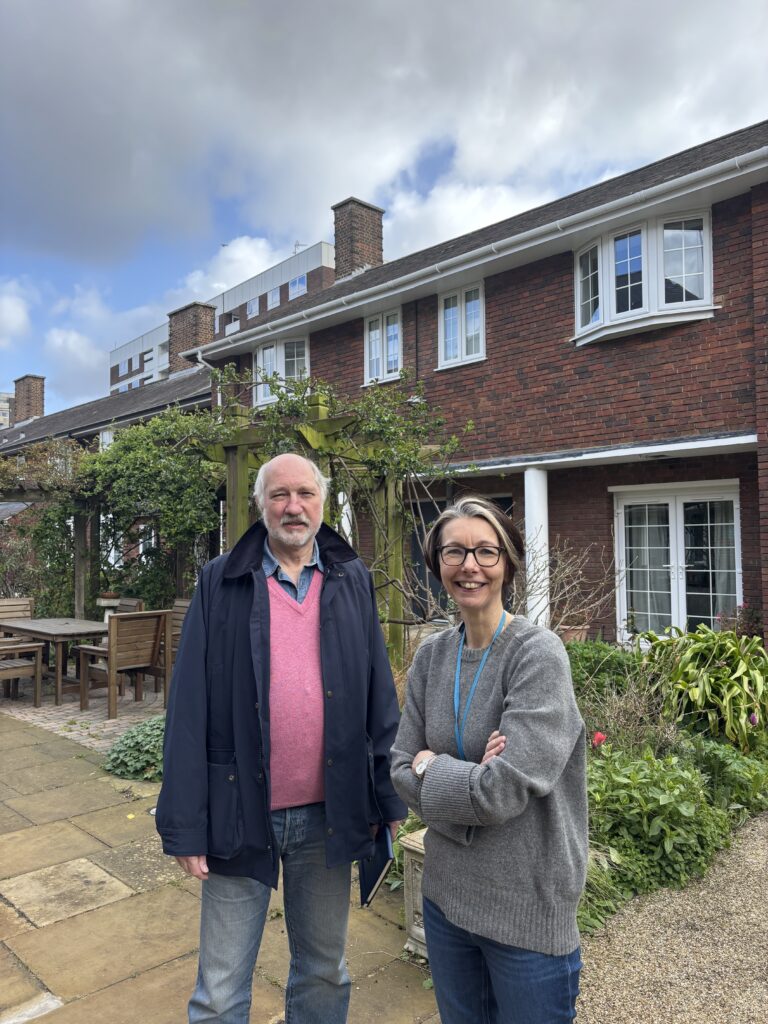
The founding donation was £20, given by a local benefactor connected to Bishop King — the same Bishop King that King Street is named after. Guy Vincent, HUC’s recently appointed Chair and a Brackenbury resident himself, explains that the charity has since received further endowments from local dignitaries, including Bishop Latimer (yes, the same one behind Latimer Road and Latimer School), and has evolved to help other local charities over the centuries. “We still do what we were set up to do,” says Victoria Hill, HUC’s Chief Executive. “Provide housing for people who need it, and relief in need. The relief in need in 1618 was beef, bread and beer. Now it’s grants to vital community organisations such as food banks, youth groups or debt advice services.”
What is an almshouse?
Many almshouses are very ancient institutions , the oldest in England is thought to be around a thousand years old. They are always charitable organisations, usually with an endowment to enable them to provide additional support to their residents, a focus on community and resident wellbeing and with eligibility criteria set by their founders. HUC’s criteria have modernised considerably since the days when they could only admit, as Victoria puts it with a smile, “eight Unitarian spinsters of good character.” Today, residents must be 60 or over, on a low income / assets, and have lived in Hammersmith as an adult for at least five years.
What HUC offers in return is significant: a self-contained flat with its own front door, daily welfare checks if wanted, communal gardens and lounges, regular activities and coffee mornings, and the security of knowing you can stay for the rest of your life. That last point matters more than it might seem. “Quite a lot of people who move in here have never actually had secure housing,” says Victoria. “For some people it’s the first time they’ve had their own front door, where they can lock it and not answer to anyone.”
Sycamore House has 52 flats plus a guest flat for family members. John Betts House, near Stamford Brook, has 40. Between them they house 92 residents, and flats at both sites are currently available.
Who lives here?
The residents are as varied as Hammersmith itself. Victoria describes the profile as a kind of demographic time-lapse of the borough: “If you look at immigration to Hammersmith over the years and add about 40, that’s what our profile is.” There are residents from the Irish wave of the 50s and 60s, from the Windrush generation, from the Balkan diaspora of the early 90s. There are lifelong Londoners alongside people who came from elsewhere in the UK.
What most share is a working life spent in the kinds of jobs that don’t come with generous pension schemes. “Hospital cleaners, child care workers, carers, shop workers – people who’ve had good, honourable jobs,” says Victoria. “Exactly the sort of people we were clapping for during Covid. But there isn’t sufficient provision for them to live in the community they raised their families in, where they paid their taxes. They’re priced out.”
People find their way to HUC through various routes: posters in lunch clubs and community centres, word of mouth from current residents, occasionally referrals from health services. Some have been waiting to turn 60. Others arrive in crisis: following a bereavement, a fall, an eviction notice. Those facing homelessness go straight to the top of the waiting list.
More than housing
HUC’s work extends well beyond its two almshouses. Each year it distributes around £350,000 in community grants to organisations working in Hammersmith. These are deliberately targeted at smaller, hyper-local groups – the average grant is around £8,000 – where that sum can make a real difference. Recent recipients include Hikayetna, which addresses mental health stigma within Arabic-speaking communities; Nourish Hub, a pay-what-you-can community kitchen near Edward Woods estate; the Sulgrave Youth Club; and the Baron’s Court Project, which works with people experiencing homelessness.
There are two grant programmes: Community Grants (up to £15,000, open twice a year) and Flexible Three-Year Grants (for organisations HUC already funds, offering stability and longer-term planning). Full details and application guidance are at hamunitedcharities.org.uk/grants.
HUC also takes a broader community role seriously. A recent project funded short documentary films for five of its grant recipients, which were screened at Riverside Studios. The charity is a founding partner of H&F Giving, a separate initiative designed to channel donations from local businesses and individuals into community causes across Hammersmith and Fulham.
Get involved
HUC welcomes enquiries from potential volunteers, particularly for its award-winning gardens at Sycamore House and John Betts House. The ideal volunteer is someone who can commit to coming regularly — once a week or once a fortnight — rather than a one-off. Volunteers work alongside the in-house gardeners and often alongside residents, so it’s as much about community as horticulture. A DBS check is required.
If social media is more your thing, HUC would also welcome someone with a bit of creative flair and some time to spare.
To find out more about any of the above — housing, grants, or volunteering — visit hamunitedcharities.org.uk or email info@hamunitedcharities.com.